Lifestyle and Postural Recovery Program
Your pain is not random. It is the result of how you sit, move, study, or work and that means it can be changed.
Lifestyle and Postural Recovery Program
What It Is:
A structured recovery and retraining program for musculoskeletal pain that originates from daily habits, sustained postures, occupational load, or movement patterns. Designed for patients whose pain is not the result of a single injury but of accumulated strain that has reached a threshold.
Who It Is For:
- Students with neck, upper back, or shoulder pain from sustained study postures
- Office workers and desk-based professionals with postural or repetitive strain complaints
- Patients whose pain builds through the week and eases on weekends
- Anyone whose pain is clearly linked to how they live and move day-to-day
- Patients with mild to moderate spinal findings on imaging disc bulges, early degenerative changes, mild scoliosis who have been advised that physiotherapy is the appropriate first-line treatment
- Patients with pelvic asymmetry, sacroiliac joint dysfunction, or gynaecological-adjacent complaints where pelvic floor, postural, or alignment factors have been identified as contributing including those referred by a GP or specialist for physiotherapy assessment
- Recurring complaints that have never had a clear structural explanation

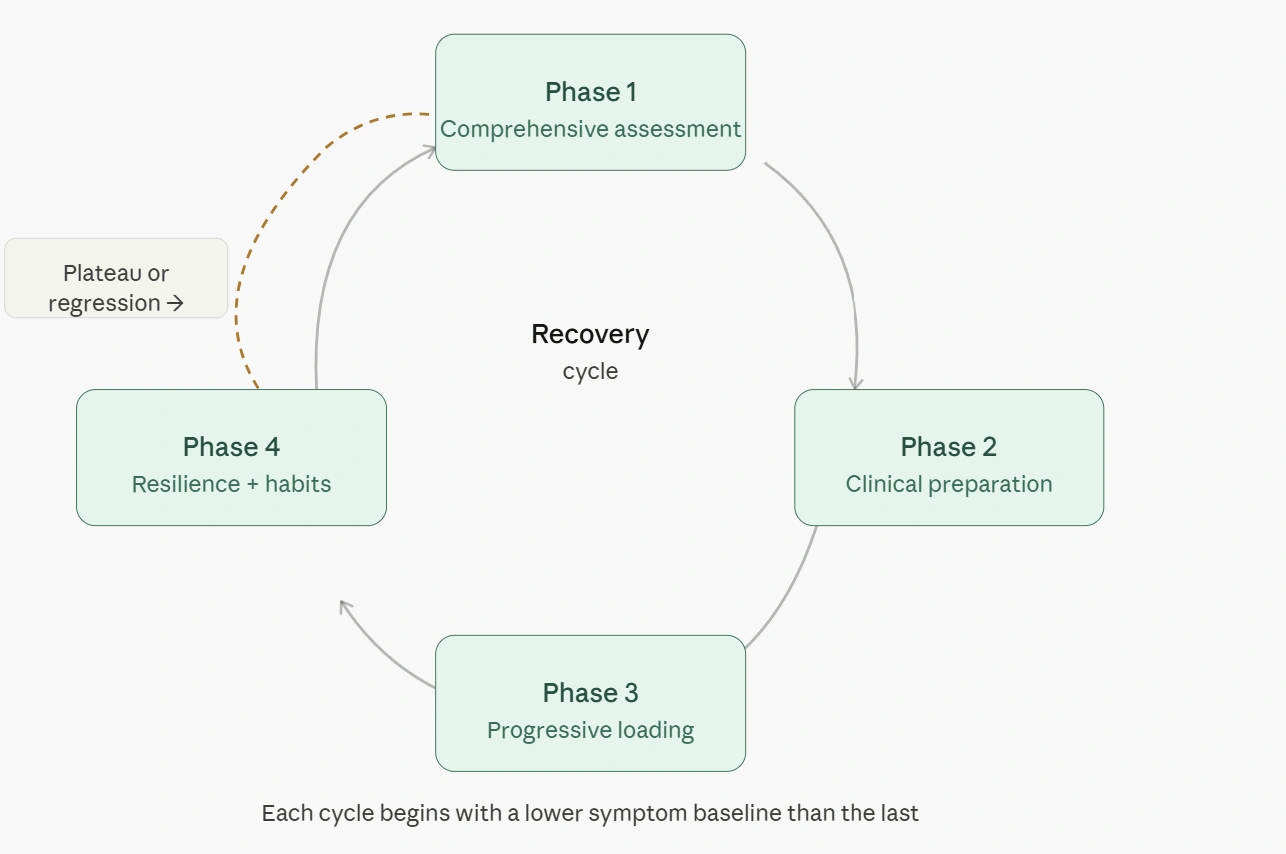
How it unfolds
Comprehensive assessment
Movement, posture, load habits, occupational and lifestyle factors, existing fitness baseline.

Clinical Preparation
Pain management, early rehabilitation, postural correction foundation. Exercise programming is built around your current activity level whether that is gym training, Pilates, bodyweight work, or starting from scratch. Your existing routine is not discarded; it is assessed, modified where necessary, and built upon.
Movement retraining and graduated loading
Progressive exercise integrated with your preferred training modality. Gym-based, Pilates-based, or bodyweight programming developed to match your capacity and goals.
Long-term resilience and habit integration
The phase that makes results stick.
How it Works
How The Cycle Works
Recovery is not always linear. Most patients move through Phases 1-4 progressively but when symptoms plateau or temporarily increase, the program cycles back to reassessment rather than continuing blindly. Each cycle, the clinical picture is clearer, the baseline is higher, and the adjustments are more precise. A plateau is not a setback. It is a signal to reassess and recalibrate.
What Makes It Different:
Progress is tracked between every session. When you return, your clinician already knows what has changed and what to adjust. Recovery does not pause between appointments.
Outcome:
Resolution of the recurring pattern, restored physical capacity, and practical tools to manage your body within your real daily life.